Burning in Mississippi falls under two sets of rules. The Mississippi Forestry Commission issues burn permits for forestry and agricultural burns. Burning land-clearing debris, yard waste and storm debris falls under MDEQ rules and local ordinances instead. On top of both, a county burn ban can stop almost all outdoor burning. Here is how each piece works, based on what the agencies publish, so you can sort out what applies before you strike a match.
Two kinds of burning, two sets of rules
The Mississippi Forestry Commission says permits are required for any fire set for a recognized agricultural or forestry purpose. Think prescribed burns in pine timber, field burns and similar work. Those permits are issued day by day based on the fire weather forecast. The permit system is built for burns with a purpose on forest or farm land, not for burning trash or yard waste.
The Commission also says its permits cover only forestry and agricultural burns. Residential, land-clearing and storm debris burning falls under local ordinances and MDEQ guidelines. MDEQ does not issue open burning permits, but its rules in 11 Miss. Admin. Code Part 2, Chapter 1 must be followed. So if you are burning windrows from a clearing job, the MFC permit is not the main rulebook. MDEQ's rules and your county or city are.
How to get a Forestry Commission burn permit
In August 2025, the Commission moved forestry and agricultural burn permits to an online system, reached from the Request a Burn Permit page on mfc.ms.gov. The application asks for the county, whether it is a day or night burn, the responsible party and whether that person is a certified burn manager, the purpose, the landowner's name, email and address, and the acreage.
Timing matters. Day permits are issued after the morning fire weather forecast posts, usually between 6 and 7 a.m., and requests made before then are denied. Night permits open after the evening forecast, usually around 3 to 4 p.m. A newer forecast can close the window, so apply promptly. The Commission also posts a map of current permits so first responders can see authorized burns.
Why a permit can be denied
The Commission lists several reasons a request will not be approved: an active county burn ban, red flag fire weather, an MDEQ air quality alert, or a poor smoke dispersion forecast. For day burns, that means low mixing height combined with light transport winds. For night burns, it is a stagnation index of 3. The Commission also notes that a permit does not guarantee a burn is safe. It points landowners to its Voluntary Smoke Management Guidelines for planning around roads, homes and other smoke-sensitive areas.
Prescribed burns and liability
Mississippi's Prescribed Burning Act gives landowners extra legal protection when they meet four conditions under Section 49-19-307: a certified prescribed burn manager supervises the burn, a written prescription is prepared and notarized beforehand, a Forestry Commission burn permit is obtained, and the burn follows state air pollution rules. Miss one of the four, and that extra protection does not apply.
When those conditions are met, the law says the property owner or agent is not liable for damage from the fire or smoke unless negligence is proven. The Commission certifies prescribed burn managers and teaches burn plan writing. If prescribed fire is part of your plan for timber or hunting land, that training is worth looking into.
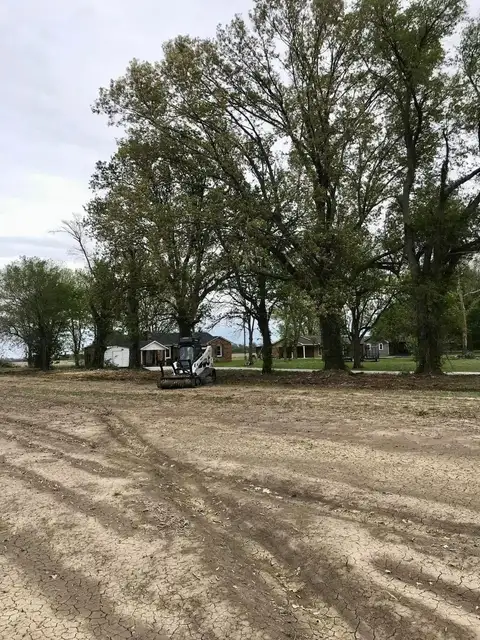
Burning land-clearing debris
MDEQ allows open burning of land-clearing debris with conditions. Without a forced-draft air system, the burn must be at least 500 yards, about a quarter mile, from any occupied dwelling. With a forced-draft air curtain system, it can be closer than 500 yards but not within 50 yards of an occupied dwelling. It also cannot be within 500 yards of commercial airport property.
The burn cannot happen where local ordinances prohibit it, cannot create a traffic hazard, and cannot take place during a Forestry Commission high fire danger alert or an emergency air pollution episode alert. Starter fuels that make heavy smoke, like tires and plastics, are not allowed. On a lot of Delta tracts with houses nearby, the 500-yard rule alone rules out an open burn.
What you can never burn
MDEQ's fact sheet lists materials that are prohibited: residential, commercial, institutional or industrial solid waste; garbage and rubbish containing garbage; hazardous waste; plastic and vinyl; and rubber tires. Burning residential structures is forbidden. That last one matters on demolition jobs. MDEQ says it is never OK to burn a residential structure, with the only exception being a firefighter training event pre-approved by MDEQ's asbestos program. An old house or trailer has to be torn down and hauled, not burned in place.
Burn bans
Under Section 49-19-351, once the Forestry Commission determines drought or wildfire conditions exist, a county board of supervisors can order outdoor burning restricted or banned in all or part of the county's unincorporated areas. The Commission's burn ban page says the board normally requests the ban, the Commission approves it, and the sheriff's department enforces it.
During a ban there is no outdoor burning of any kind: no campfires, bonfires, burn barrels, debris burning or field burning. Gas and charcoal grills used as directed are allowed. Each ban lists either no exemptions or specific ones, such as certified burn managers or commercial contractors meeting MDEQ rules. Bans expire at midnight on the stated date. Knowingly violating one is a misdemeanor with a fine of $100 to $500.
Before you burn
Check the Forestry Commission's burn ban page and ask your county whether a ban is active. Know whether your burn is forestry or agricultural, which needs an MFC permit, or land-clearing or yard debris, which falls under MDEQ rules and local ordinances. Measure the distance to the nearest occupied house. Keep tires, plastic and trash out of the pile.
If burning will not work on your place, plan the debris another way before the clearing starts. Windrows can be left to rot or handled other ways. Call or text B&M at 662-719-7737 and we can talk through clearing options that fit your tract. It is easier to plan where windrows go before the machines start than to move them later.
Need this done? B&M Land Management gives free estimates from Ruleville. Call or text 662-719-7737.
Free estimate