
What OSHA requires
OSHA's materials handling rule, 29 CFR 1910.176(a), says that where mechanical handling equipment like forklifts is used, there must be safe clearance for aisles, at loading docks, through doorways and wherever turns are made. Aisles and passageways must be kept clear and in good repair, and permanent aisles and passageways must be appropriately marked.
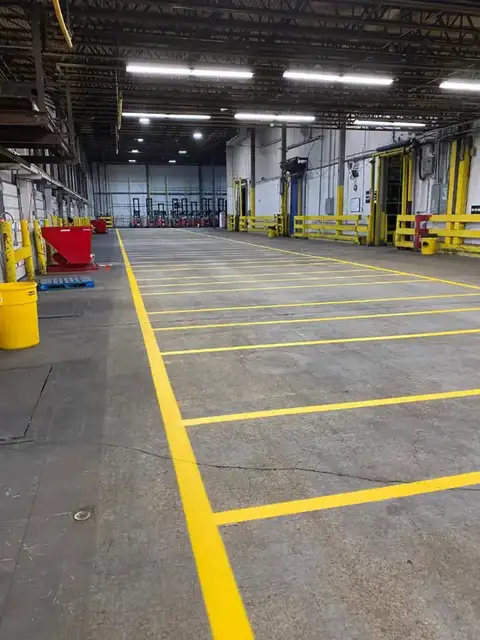
The walking-working surfaces rule, 1910.22, requires floors and passageways to be kept clean, orderly and free of hazards. OSHA's forklift guidance recommends separating pedestrians from lift trucks with walkways, railings or barriers, and pedestrian walkway striping on the floor where barriers cannot be used. Painted lines are the common way to meet the marking rule on a concrete floor.
Colors: practice, not a single OSHA rule
OSHA does not set one required color or width for aisle lines. Its safety color rule, 1910.144, says red identifies fire protection equipment and danger, and yellow designates caution and physical hazards. Beyond that, the choice is left to the employer, so most plants follow a color plan based on ANSI standards or common industry practice and use it the same way in every building.
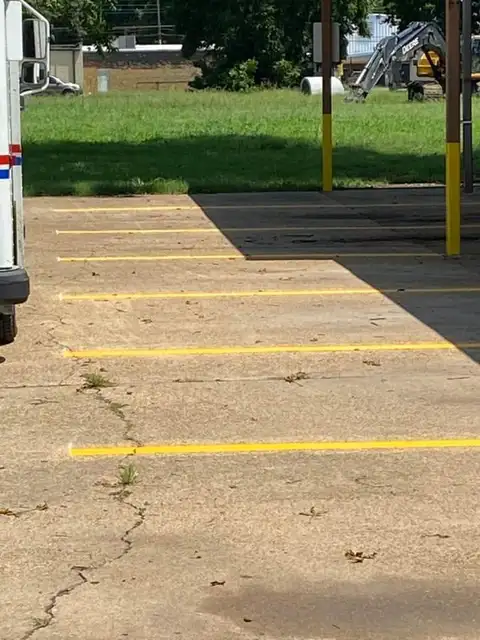
A common plan uses yellow for traffic lanes and aisles, white for equipment and racking, red for fire equipment areas, and other colors for staging or quality holds. The most important thing is that your plan is written down, used the same way across the building, and taught to the people on the floor. Tell us your plan, or we can talk through one with you.
Laying out the floor
Aisle width depends on your equipment. A sit-down counterbalance forklift needs more room to turn than a narrow-aisle reach truck. We measure from the racking and the turns your drivers actually make, not just the drawing. Lane lines go where the trucks run. Bay lines show where product stops. Walkways run along the walls or between zones where people really walk.
Exit routes must stay free of obstructions, so we mark the path to each exit door and keep-clear boxes in front of fire extinguishers, electrical panels and doors. Dock doors usually get staging lanes so loads do not block the main aisle. A good layout makes it obvious when something is in the wrong place.
Concrete prep and keeping the floor open
Paint on concrete only lasts if the floor is ready. Dust, oil, tire marks, curing compounds and old coatings keep paint from bonding. The floor needs to be clean and dry, and greasy spots need extra work. Sealed, polished or epoxy-coated floors need different prep than bare concrete, so tell us what is on your floor when we talk.
Most warehouses cannot shut down to stripe. We can plan the work in zones, so one section is taped off while the rest keeps running, and work around your shifts or a slow day. Forklift traffic has to stay off fresh lines until they are ready. We work out a schedule with you before we start.