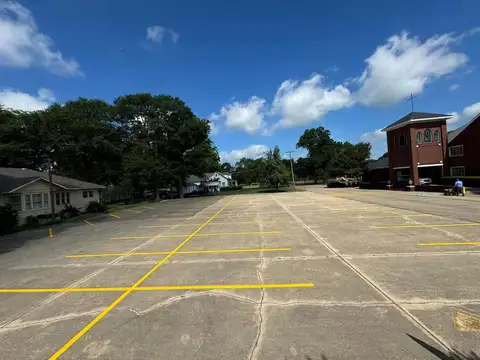
Fresh asphalt and fresh sealer both need time before paint goes on. How long is not one number. It depends on the surface, the sealer, the paint and the weather, and the published waiting periods we checked range from a day to a month. The manufacturer's directions on the sealer and the paint come first, along with any spec the owner or engineer has written. Here is how it works.
Why striping has to wait
New asphalt has light oils on the surface when it is first laid. One traffic paint data sheet we checked says new asphalt should cure until it is free of those light oils, which it puts at 4 weeks. Sealer has to dry and cure too. A county sealcoat spec says to keep traffic off until the seal coat is cured enough to resist damage, and that the time varies with the mix and the weather.
Paint applied before the surface is ready is going down on a base the manufacturer says is not ready. That is the main reason to wait, and the main reason to read the labels before scheduling. Lines that bond poorly or track across the lot have to be redone, which costs more than waiting a few extra days.
New asphalt: weeks, not days
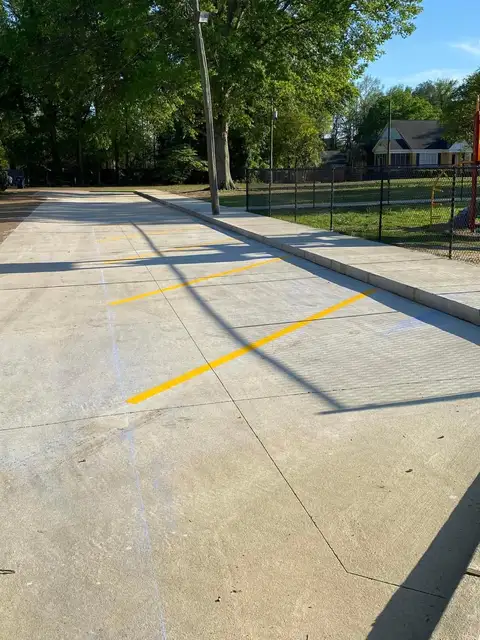
Owner specs we checked for parking lot striping on new pavement ask for anywhere from 14 to 30 days. A county parking lot spec says to let new pavement cure at least 14 days before marking. A university spec says to let paving age 30 days. The paint data sheet says 4 weeks.
If the lot will also be sealcoated, the sealer has its own wait. One county sealcoat spec says new pavement should cure at least 30 days under ideal conditions, around 70 degrees F, before sealing, and patched areas at least 15 days. If the lot has to open sooner, talk with the paving contractor and the owner about how to handle it.
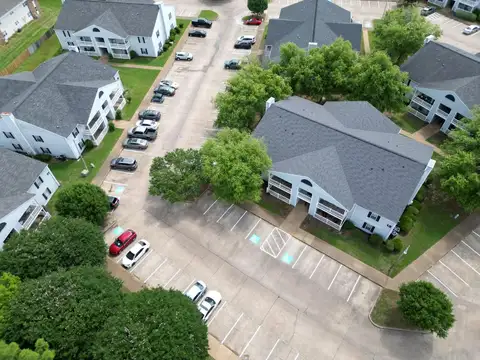
After sealcoating
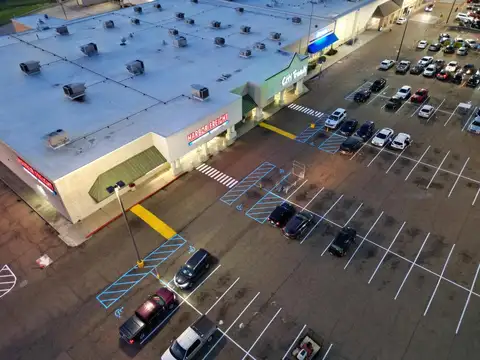
Here the spread is wider. The paint data sheet we checked says to let fresh pavement sealer cure at least 24 hours before applying traffic paint. A university striping spec says paint shall go down no sooner than 14 days after seal coat. Both are real published numbers. One is a product minimum, and the other is an owner choosing to wait longer.
The safe rule is to follow the strictest requirement that applies: the sealer manufacturer's directions, the paint manufacturer's directions, and the project spec. Ask your sealcoat contractor for the product data sheet and share it with your striper. If the sealer and paint labels disagree, go with the longer wait.
New concrete
Concrete has its own timeline. The county parking lot spec we checked says not to paint concrete until it has cured 28 days. Concrete also needs more careful prep. A Texas DOT research synthesis notes that surface prep is more involved on concrete, and that prep of concrete is vital to marking performance. That applies to new concrete aprons, sidewalks along accessible routes, and warehouse floors.
Weather matters as much as the calendar
Sealer and paint both have temperature limits. The county sealcoat spec calls for surface and air of at least 50 degrees F and rising, no drop below 50 for 24 hours after, and no rain forecast for 24 hours. For water-based paint, a university spec sets 50 degrees F as the minimum and 95 degrees F as the maximum. The paint data sheet lists 40 degrees F, with no drop below 40 for 24 hours.
In practice that can mean waiting out a cold snap, starting early on a hot summer day to stay under a 95 degree cap, or moving the job when rain is in the forecast. Paint needs a clean, dry surface either way. A morning dew or a puddle left from an overnight shower can hold up the start even on a warm day.
Record the layout before sealing
Sealer covers the old lines, so measure and photograph the layout before the sealcoat crew starts. Some sealcoat specs call for abrading existing markings first, which takes them off the map entirely. On the striping side, one county spec has the contractor spot line locations 25 feet on center before painting.
This is also the time to fix the layout. Under Access Board guidance, resealing is an alteration, and accessible spaces must be provided when a lot is resurfaced or reconfigured. Check your accessible stall and van space count before the new lines go down. A clean, black surface is the easiest time to move a stall, widen an aisle or add a van space.
Coordinating the sealer and the striper
Block off areas until both the sealer and the paint are ready for traffic. The sealcoat spec says areas must be marked to prevent entry until dry, and the county striping spec calls for protecting fresh lines at least 30 minutes or as the manufacturer recommends. Straight Line Services stripes new and sealed asphalt in Mississippi, Louisiana, Tennessee, Alabama and Arkansas. Tell us your sealcoat date and product, and we will plan the striping around it. Call or text 662-719-7737.
Need this done? Straight Line Services gives free estimates from Ruleville. Call or text 662-719-7737.
Free estimate